
By Brian Kuhn, BBGH Marketing Department
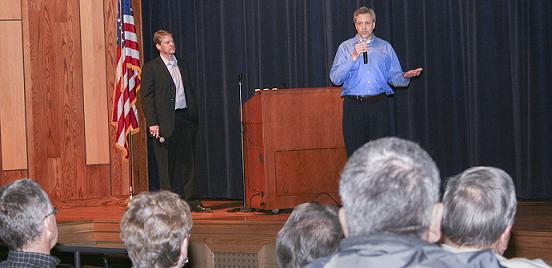
BWBR architects Jason Nordling (left) and Scott Holmes co-hosted the PowerPoint presentation during the Town Hall meeting held Tuesday, February 26 at the Performing Arts Center. Those attending were also able to view samples and photos of material and color schemes chosen for the exterior and interior of the building.
Box Butte General Hospital held a town hall meeting Tuesday, February 26 at the Performing Arts Center in Alliance on the new addition/renovation project. They received a large amount of information about how the design process was conceived and influenced by input from BBGH staff and community focus groups. One question not asked that evening, but has been asked in small meetings with various civic groups and by individuals, is how BBGH intends to finance the new addition/renovation project. CEO Dan Griess answers that question at the end of this article.
Mr. Griess opened the meeting with a brief history of the project before introducing two representatives from the hospital’s architectural firm BWBR. “We actually began this process three years ago,” he said. “The first part of the project was an $800,000 electrical upgrade of our existing facility. That was completed last year. We then decided to go forward with a two story addition to our building, along with renovation of our rehabilitation department to provide more room for that service.”
He introduced BWBR architects Jason Nordling and Scott Holmes. Both walked the audience through a PowerPoint presentation of the design concept process and most recent architectural renderings of the addition.
Mr. Nordling said the most important aspect of the initial design process was getting feedback from hospital staff and the community on what they feel the hospital represents to them and how they envisioned the new addition. A series of focus group meetings were held with community members and staff, both administrative and on a departmental level.
“We asked a lot of questions and received a lot of feedback over the early visioning process,” he said.
Most feedback from BBGH staff dealt with efficiencies and functionalities. But most of the feedback on how the new addition will look came from the community focus group meetings and their answer to the question, “What would we like the first impressions of the hospital to be?” A few of the answers included:
- Welcoming, Inviting, Confident, Comfortable, Modern
- Bright, Light
- Areas that “pop”, make a statement, eye catching…Areas that are “quiet,” go away
- Safe, Clean, Secure
- Clarity…There’s no doubt where to go…better Way-finding
- Not institutional, a Healing environment, Non-imposing, Non-threatening, Not closed in or small
- A sense of Pride – “My hospital”
- Partners in care
- Worth the trip
- Healthcare events
- Be a model for others
- Progressive & Innovative
- Sends a positive message
- Worth the Investment
Mr. Nordling said the colors schemes, openness and modern design of the addition tries to emulate those visions. Pointing to a slide showing a modern looking fireplace in the surgery public waiting area west of the main entrance, he said, “This fireplace may not be in the final design, but it’s there to illustrate a point. It’s a proven fact that using color and providing a homelike environment with variety of styles of furnishings help to create a healing environment. Studies have shown that doing so provides better patient stays and outcomes.”
Mr. Holmes went over the preliminary inside architectural plans, many of which have been presented before to the public through recent media press releases including:
- Reducing public entries to just three on the west side of the addition to promote better way finding
- A new entry to The Rehab and Wellness Center on the east side of the existing building
- How the new addition eliminates the problem of way finding, making out-patient public access points available along the curved concourse fronting the entire west side of the building and Medical Arts Plaza
- Consolidating as many patient care services as possible to one area of the campus
- Providing a separation of post-partum childbirth suites from Patient Care Unit rooms
- Providing rooms where patients can be taken for discharge instructions
- Having the pharmacy department on the 2nd floor to be near patients
Some new design features include placing the chapel near the front entry of the addition, as well as placing an information desk near the same location in front of the new space for The Gift Shop.
“We’ve really tried design this building so that it removes as much of the back end operational activity from the public areas, such as maintenance and environmental services; even having separate doors for medical staff to enter exam rooms,” Mr. Nordling said. “That was in response to the community vision of “quiet” areas going away.”
The audience asked several questions at the end of the presentation, including parking space availability near the emergency department once it is completed. Mr. Nordling pointed out where parking would be available west of the department along Box Butte Ave.
Another concern expressed was how the hospital planned to keep the large, two storied glass portion of the addition cool during hot summer days. Both architects said protruding framework will provide shade during the summer when the sun is at its highest zenith. If additional shading is deemed necessary, “built in” shading may be provided or specialized glass installed. “We aren’t at that part of the design process yet,” Mr. Holmes said, “but it will be discussed.”
When asked about additional public areas, he answered, “Besides the large public area concourse fronting the first floor of the building, additional public areas on the second floor: includes one near the post-partum suites on the north side of the floor and one near the patient care unit on the south side of the floor.” There is also a public area for people using the Emergency entrance.
One question that was not asked during the town hall meeting was how BBGH intends to finance the new addition/renovation project. It is an important question that has been asked at previous smaller meetings and from individuals.
As a Critical Access Hospital, BBGH receives 101% of allowable costs from Medicare and 97.5% of allowable costs from Medicaid. Construction is considered an allowable cost which means BBGH will receive funding from Medicare and Medicaid equal to the percentage of patients who are Medicare or Medicaid. “For example,” Mr. Griess said. “If 62% of the patients cared for by Box Butte General Hospital are either Medicare or Medicaid, approximately 62% of the costs related to the construction, equipment, design, etc. will be considered allowable expenses through our cost report and eventually will be reimbursed by Medicare and Medicaid to BBGH.” The balance of the financing will be covered through operational gains.
“Other businesses would have to increase prices, sell more products or reduce expenses to finance a similar project,” he concluded. “ Since we are paid predominately by the cost of providing care through Medicare and Medicaid, increasing prices does not have a significant impact on our revenues. Raising prices would impact revenues through insurance company reimbursements or self-pay reimbursements but these only account for less than 35% of our business. Additionally, there are limitations through these business models due to negotiated fee schedules or small discounts.”
BBGH is a non-profit, county owned 25-bed Critical Access Hospital. The mission of BBGH is to lead and innovate in healthcare delivery and community wellness.
